





Keloids are large sometimes dumbell shaped scars that grow out of the confines of the original wound. Most ear keloids are caused by ear piercings. They are most common in Afro Americans but occasionally are found in Hispanics and Asians. Keloids do not respond to silicone sheeting. Virtually all keloids that are cut out will return within 2 to 3 months if steroids and pressure are not applied after surgery. Since acrylic pressure earring compression plates can be applied almost anywhere along the ear radiation is rarely used to prevent ear keloid recurrence. Although the exact skin condition prior to keloid formation cannot be reached vast improvement is possible.
If the keloid is causing a functional problem such as visibly blocking the ear canal or has a history of recurrent infections its removal is covered by health insurance. In California state laws mandate coverage of the removal of all visibly large keloids.
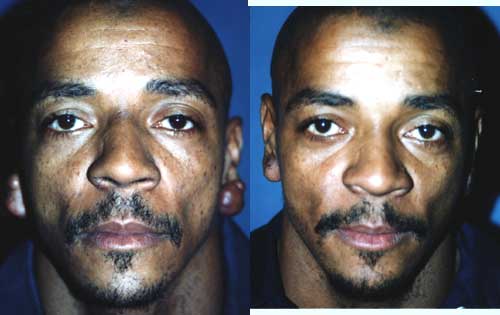
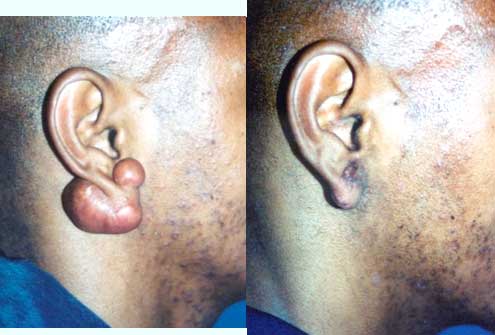
Afro-American with ear keloids from ear piercing. This is the type of keloid clearly covered by health insurance in California.
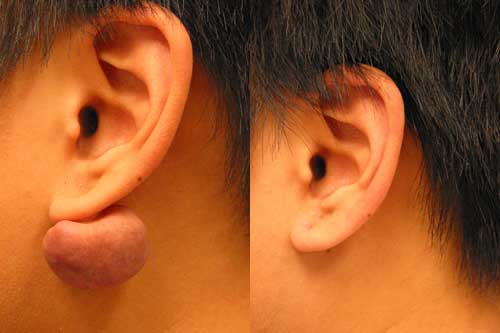
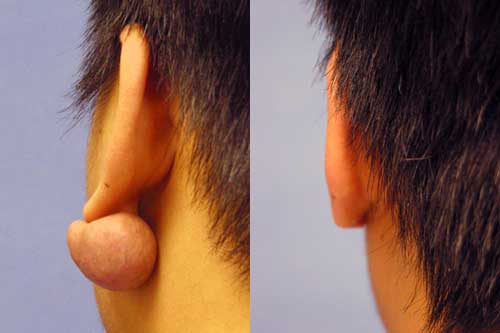
Asian with ear keloid from ear piercing.
Read Dr. Stone’s blog about Scars, Keloids and Hypertrophic ScarsScars, Keloids and Hypertrophic Scars
Keloid surgery can enhance your appearance and your self confidence. Realistic expectations are important to be happy with any surgery. As each patient is an individual, different results can be expected in each patient.
Alternatives
The alternatives include laser or cryotherapy ablation vs. surgical removal. There is no major advantage of one over the others because the main goal is the prevention of recurrence. It matters more what you do to keep it from coming back than what you do to remove the keloid.
The options to prevent recurrence are compression garments, scar injections, medicated tape and weekly office visits vs. radiation and medicated tape. For ear keloids only those patients live too far away to come in for weekly office visits go the radiation route for prevention.
Risks
As with any type of surgery there is the risk of infection or bleeding. If radiation is used there is a risk of burns or future skin cancer. With appropriate care the risk of these is extremely low. You have to pick your radiation doctor carefully and it may be safer to go with a non-participating provider than a doctor who participates with your health insurance.
If the keloid is large enough and/or the surrounding skin tight enough you will not be able to have the keloid completely removed. In that case it is shelled out and some of the overlying skin removed. The highest risk then is incomplete survival of the shell skin. This usually does not affect the end result but can prolong the recovery period.
Benefits
The benefits are not having a raised, hard scar that may itch, periodically get infected or interfere with movement. Patients who ride motorcycles find it easier to put on and take off their helmets.
Recovery If the radiation route is chosen radiation treatments begin within 24 hours for a total of 3 treatments. The acrylic pressure plates should be obtained before surgery to ensure that can be applied as soon as is appropriate. Scar injections are performed at and 1 week after surgery. Sutures are removed at 10 to 12 days and the pressure device is then applied at all times except when bathing for 3 to 6 months. Initial office visits are weekly and then are gradually extended to every 2 to 3 weeks.
Dr. Aaron Stone
Call today for a consultation!
9700 Venice BlvdCulver City, Los Angeles,CA 90232
Many people who are interested in Plastic Surgery decide not to seek treatment because of the prices associated with cosmetic plastic surgery. What they may not know is that financing plans can help manage the costs and bring cosmetic surgery within the reach of nearly every budget.Many patients choose their cosmetic surgeon based on prices for plastic surgery rather than credentials. It is important to thoroughly research your doctor to ensure that he or she has the requisite training, experience, and facility. Making sure you get the results you desire the first time around could mean lower cosmetic surgery costs in the long run. Choosing an inexperienced surgeon could jeopardize your safety and result in health problems or the need for follow-up surgeries.Dr. Stone offers patients a range of payment options to help cover plastic surgery costs, including cash, check, and credit cards. In addition, he offers plastic surgery financing plans to help patients set up an affordable payment schedule by breaking up the costs of Plastic Surgery treatment into affordable monthly payments through


You can finance 100% of your cosmetic surgery and select the plan that works best for your budget. There are no upfront costs, no annual fees, and no pre-payment penalties. So, you can schedule your procedure today and conveniently pay with low, monthly payments. Many of Dr. Stone’s patients use the financing option and their is no stigma attached to doing so. Everyone is treated equally regardless of whether their procedure is paid by financing, up front cash or credit card. We encourage all prospective patients to feel free to discuss financing options during their office consultation.
Please remember not to choose your cosmetic surgeon based solely on prices for plastic surgery rather than credentials. It is important to thoroughly research your doctor to ensure that he or she has the requisite training, experience, and facility. In addition you should feel comfortable with the Plastic Surgeon you choose. This is important because should any problems arise after surgery you need to feel you can easily call and speak with your surgeon to treat any such problems as quickly as possible. Having a good surgeon that intimidates you or that you feel uncomfortable speaking with does not help the situation. Making sure you get the results you desire the first time around could mean lower cosmetic surgery costs in the long run. Choosing an inexperienced surgeon could jeopardize your safety and result in health problems or the need for follow-up surgeries.
